

When someone is arrested, they don’t browse law firm websites casually—they search right now. In fact, 93–96% of people use search engines to find legal help, and most criminal defense searches happen under extreme urgency, often within hours of an arrest.
What’s changed is how Google decides who gets seen. In 2026, search results are increasingly shaped by AI-generated answers that summarize legal guidance before users ever click a website. If your firm’s content doesn’t clearly explain next steps—such as what to do after a DUI stop in your city or whether a first arrest requires a emergency lawyer—it may never reach the person who needs it most.
Modern criminal defense SEO is no longer about ranking generic pages. It’s about delivering immediate, location-specific answers, proving credibility through real reviews and case clarity, and guiding stressed users toward a confident phone call. Law firms that adapt to this shift don’t just gain visibility—they capture clients at the exact moment decisions are made.
SEO for criminal lawyers is the process of making your firm discoverable, credible, and immediately helpful in search results where legal decisions are made quickly. It goes far beyond keyword placement and now includes:
Modern criminal defense SEO focuses on user intent first—answering urgent questions clearly, on mobile, and without legal jargon. When done correctly, it positions your firm as the safest and most reliable option before a user ever picks up the phone.
Criminal defense clients don’t research slowly—they act under pressure. Behavioral studies in legal marketing consistently show that the majority of criminal law searches convert within the same day, often after comparing only two or three firms. Many of these searches happen late at night or early morning, when paid ads are missed and referrals are unavailable.
SEO allows criminal defense firms to appear at the exact moment urgency peaks. A well-optimized page answering, “What happens after a DUI arrest in [city]?” or “Do I need a lawyer before my first court date?” doesn’t just rank—it reassures, builds confidence, and drives immediate action. Firms that fail to address these real-time concerns lose prospects within minutes, not days.
Unlike interruptive marketing, SEO meets clients after the decision to seek legal help is already made, making it one of the highest-intent acquisition channels in criminal law.
Criminal defense SEO succeeds when strategy aligns with urgency, trust, and local intent. Google’s algorithms—and now AI-generated search answers—prioritize firms that provide immediate clarity, proven credibility, and frictionless user experience. Below are the strategies that consistently separate firms that get calls from firms that just get traffic.

Criminal defense content must do more than “rank.” It must reduce panic, answer the next steps, and establish authority within seconds. Google increasingly rewards content that demonstrates real-world usefulness—especially in legal YMYL (Your Money, Your Life) topics.
Effective criminal defense content:
Instead of generic blog posts, firms should focus on decision-stage content, such as:
Content should visibly demonstrate Experience, Expertise, Authority, and Trust (E-E-A-T), including attorney credentials, years of practice, jurisdictions served, and real case context—without violating ethics rules.
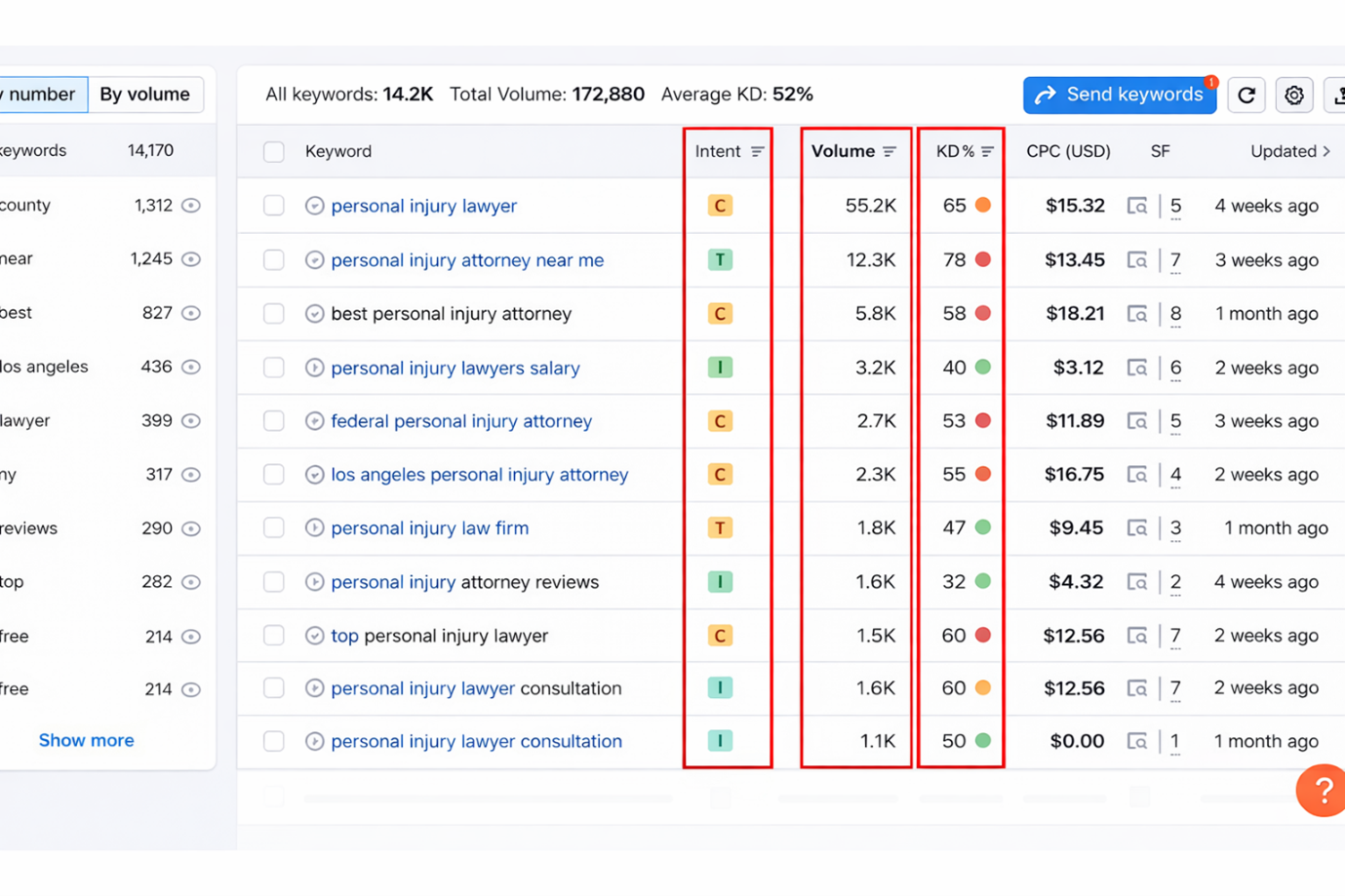
Modern keyword strategy for criminal lawyers is no longer about ranking for the broadest terms. It’s about capturing intent at the moment legal help is needed. High-performing criminal defense SEO targets three intent layers:
These indicate urgency and readiness to contact:
Used by informed users comparing options:
Often surfaced in AI Overviews:
The goal isn’t to rank for everything—it’s to own the searches tied to real cases in your jurisdiction.
On-page optimisation in criminal defence SEO must strike a balance between technical clarity and emotional reassurance. Pages should be structured so both users and AI can quickly understand:
High-impact on-page elements include:
Every page should feel purpose-built, not templated.
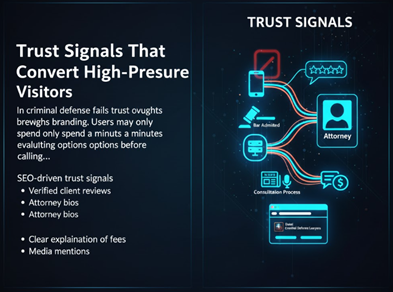
In criminal defense, trust outweighs branding. Users may only spend a few minutes evaluating options before calling—and reviews, credentials, and clarity heavily influence that decision. SEO-driven trust signals include:
Google’s systems—and users—look for consistency and legitimacy across your website, listings, and public presence.
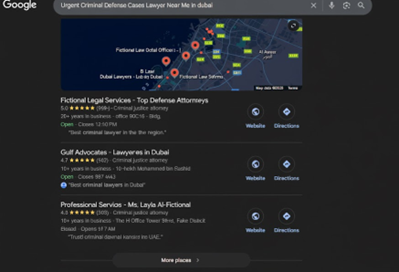
Criminal cases are inherently local. Courts, prosecutors, procedures, and timelines vary by jurisdiction, and Google expects law firm content to reflect that reality. Strong local SEO includes:
Hyper-local relevance helps firms appear in map results, AI summaries, and emergency searches. Look at the image when you search for something with “near me”, Google SERP shows you your nearby locations. This will help you get quick assistance to find what you are looking for.
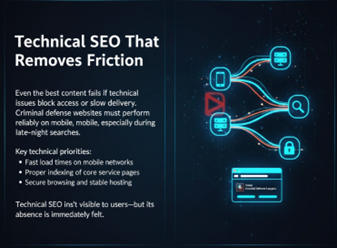
Even the best content fails if technical issues block access or slow delivery. Criminal defense websites must perform reliably on mobile, especially during late-night searches. Key technical priorities:
Technical SEO isn’t visible to users—but its absence is immediately felt.
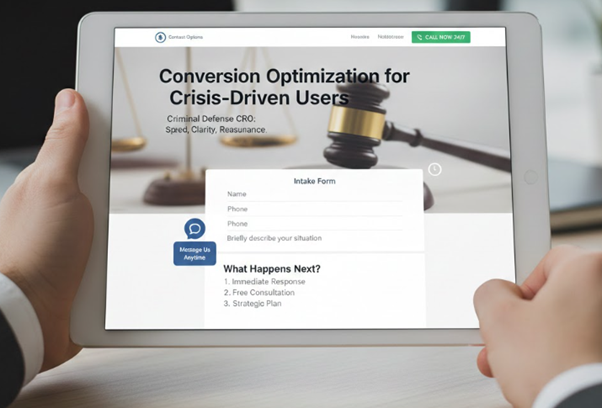
SEO traffic only matters if it turns into consultations. Criminal defense CRO focuses on speed, clarity, and reassurance. High-converting criminal defense sites typically include:
The objective is to remove hesitation, not push aggressively.

True SEO success isn’t measured by rankings alone. Criminal defense firms must track what actually leads to retained cases. Meaningful SEO metrics include:
This data enables firms to focus on what attracts genuine clients, not just clicks.
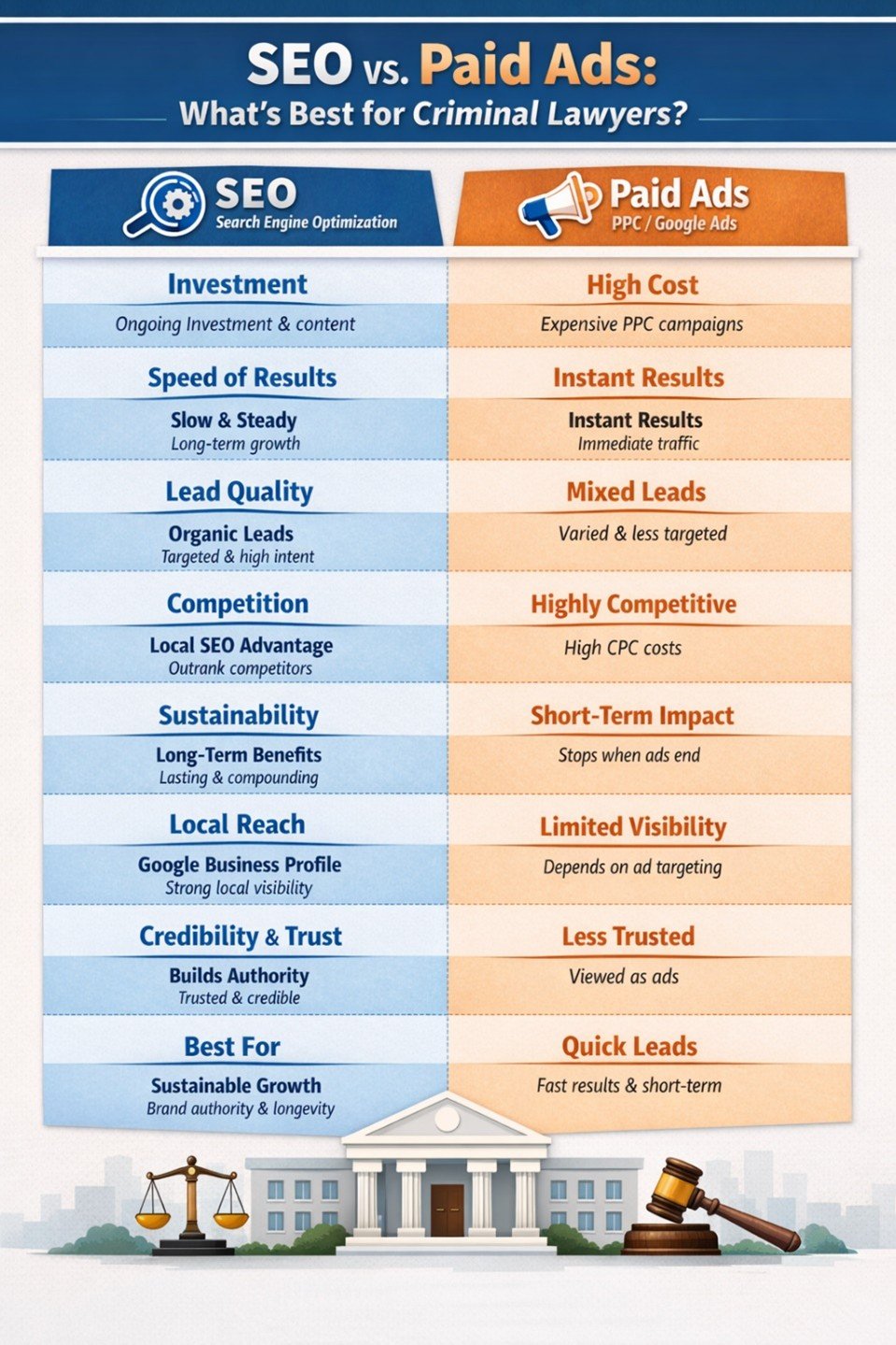
Comparison Factor | SEO (Search Engine Optimization) | Paid Advertising (PPC / Google Ads) |
Investment | Requires a steady investment over time since ongoing optimization, content creation, and technical updates are needed. | Involves a high continuous cost, as pay-per-click campaigns for legal keywords can be very expensive. |
Speed of Results | Gradual results—takes time to rank but produces sustainable, long-term visibility. | Immediate visibility—ads appear instantly, generating quick traffic and inquiries. |
Lead Quality | Attracts high-quality, organic leads who are actively searching for legal services. | Generates a mix of leads; some are relevant, others may be accidental clicks. |
Competitive Advantage | Allows you to outrank competitors through targeted local SEO, content marketing, and authority-building strategies. | Highly competitive; legal keywords have steep CPC rates, making it costly to dominate. |
Sustainability | Offers long-lasting benefits; traffic grows over time and compounds even without constant effort. | Stops producing results immediately once the campaign ends. |
Local Reach | Strong local presence via Google Business Profile and localized search optimization. | Limited local visibility; mostly depends on ad targeting. |
Credibility & Trust | Builds trust and authority naturally as your site ranks organically on search engines. | Paid ads are less trusted by users compared to organic rankings. |
Best Use Case | Ideal for firms aiming for long-term growth, brand authority, and sustainable client acquisition. | Best suited for firms needing quick leads, short-term campaigns, or immediate visibility. |
Common Mistake | Why It’s Harmful | Quick Fix |
Keyword Stuffing | Overloading content with keywords reduces readability and signals spam to Google. | Use keywords naturally. Focus on clarity and address actual search intent. |
Duplicate Location Pages | Copying content across multiple city pages confuses search engines and hurts local SEO. | Create unique, value-driven pages for each location with office info, case highlights, FAQs, and attorney details. |
Ignoring Reviews | Not collecting client reviews weakens local credibility; Google favors consistent positive feedback. | Encourage satisfied clients to leave reviews via follow-ups, email reminders, or direct links to Google Business Profile. |
Buying Low-Quality Backlinks | Cheap, irrelevant links can trigger penalties and damage rankings. | Earn links from reputable sources: legal directories, bar associations, guest posts, and credible business sites. |
Weak Content Strategy | Limited or shallow content reduces visibility and authority. | Publish in-depth content: legal guides, FAQs, case studies, blog posts, and resources covering criminal charges and defense strategies. |
Trend | What It Means | How to Adapt |
E-E-A-T Focus | Google prioritizes content demonstrating Experience, Expertise, Authority, and Trust. | Highlight attorney credentials, bio pages, thought leadership, case insights, and legal commentary. |
AI-Powered Search | Search engines now prioritize intent over keywords, with AI providing context-aware answers. | Create empathetic, scenario-based, question-driven content structured for AI summaries, long-form guides, and conversational FAQs. |
Video Content Growth | Short-form videos boost trust and engagement for clients seeking quick explanations. | Produce FAQ videos, legal explainers, and short clips that humanize your brand. |
Hyper-Local SEO | People search for criminal lawyers nearby; local relevance drives leads. | Optimize Google Business Profile, local citations, service pages with court/jurisdiction info, and neighborhood-specific content. |
No matter where your firm operates—Dubai, UAE, UK, US, or worldwide—Odyssey Marketing’s SEO consultants ensure your criminal defense practice reaches the right clients at the right moment. From AI-friendly content and hyper-local optimization to review management and conversion-focused strategies, we make your firm discoverable, credible, and trusted online. Start capturing urgent, high-intent leads today with proven SEO solutions.