

When it comes to measuring website authority, the debate between Moz DA and Ahrefs DR often sparks confusion. While both metrics range from 0 to 100 and are used to assess website strength, they’re not quite as interchangeable as they might seem. Each metric evaluates different aspects of SEO, and knowing how they truly differ can be the key to unlocking your website’s full potential.
In this guide, Odyssey Marketing SEO specialists break down what Moz DA and Ahrefs DR actually measure, why it matters for your SEO strategy, and how you can use these insights to make smarter, more effective decisions as we head into 2026.
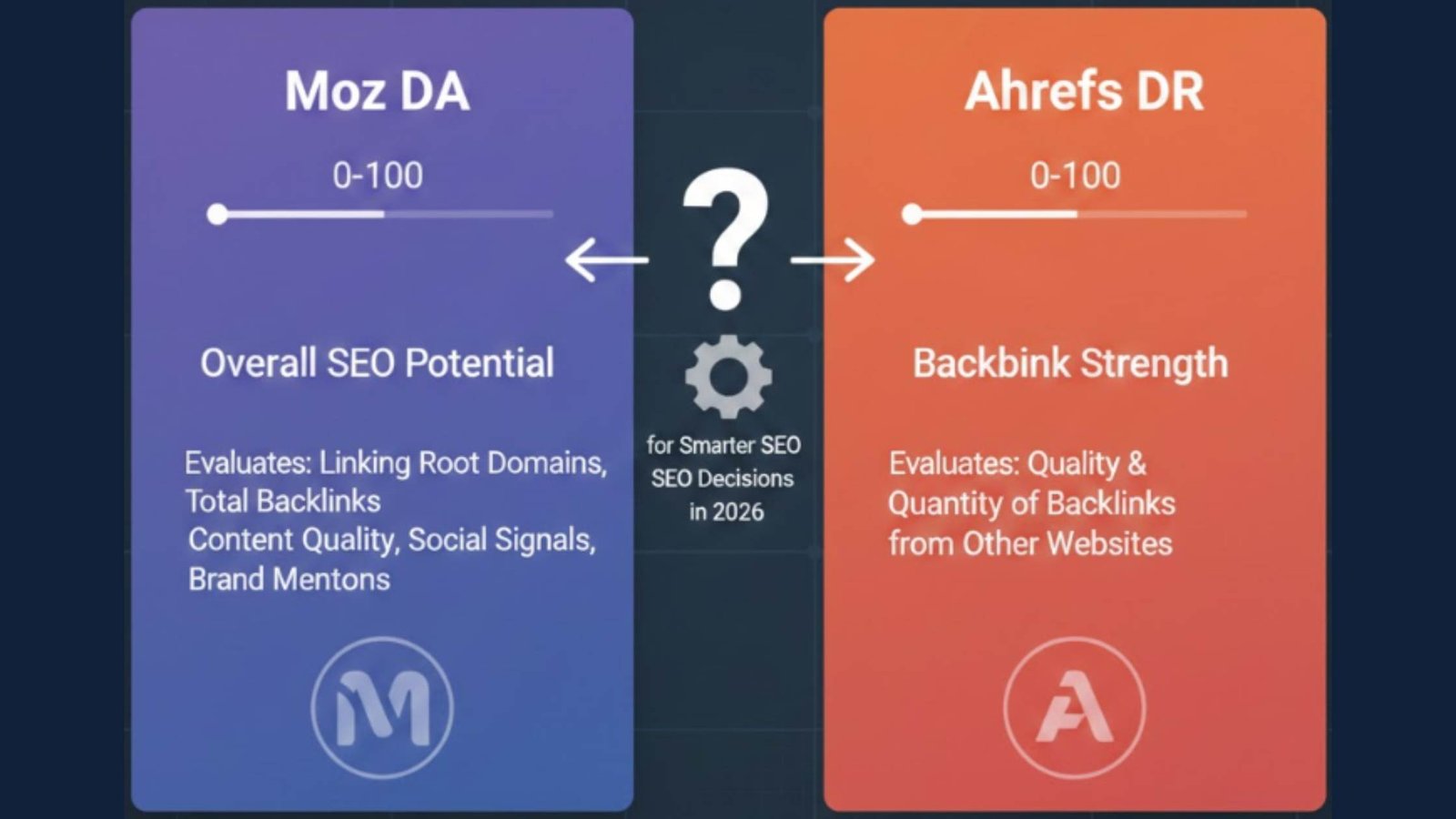
Moz DA is a predictive metric designed to estimate a domain’s ability to rank on Google. DA considers over 40 factors, primarily focused on the quality and quantity of backlinks, the number of linking root domains, spam score, and trustworthiness of the domain. Its logarithmic scale means that advancing from a DA of 70 to 80 is far harder than moving from 20 to 30, reflecting the increasing competition at higher levels. Importantly, DA is best used for comparing multiple domains in the same niche, rather than as an absolute ranking factor, as it’s built to measure relative SEO strength.
On the other hand, Ahrefs DR focuses exclusively on the strength of a site’s backlink profile. It evaluates the number of referring domains, the quality of those domains, and how evenly the backlinks are distributed across the site. Unlike DA, DR doesn’t consider on-page SEO or keyword optimization, making it a more specialized metric for assessing backlink strength. DR is updated daily, making it more responsive to recent changes, such as acquiring new backlinks or losing existing ones. This sensitivity gives DR an edge as a tool for tracking the impact of link-building campaigns or identifying potential negative SEO attacks.
Metric | Moz DA | Ahrefs DR |
Primary Focus | Overall ranking potential across various SEO factors | Strength of backlinks and their authority |
Factors Considered | 40+ factors, including link quality, root domains, spam score, and internal linking | Quality and quantity of referring domains, backlink distribution |
Update Frequency | Monthly | Daily |
Scale Type | Logarithmic (harder to increase as score rises) | Linear (each point reflects a proportional increase) |
On-Page Factors Included | Yes, including internal links and topical relevance | No, focuses only on backlinks |
Sensitivity to Link Changes | Less sensitive to recent link changes | More sensitive to recent backlink acquisition or loss |
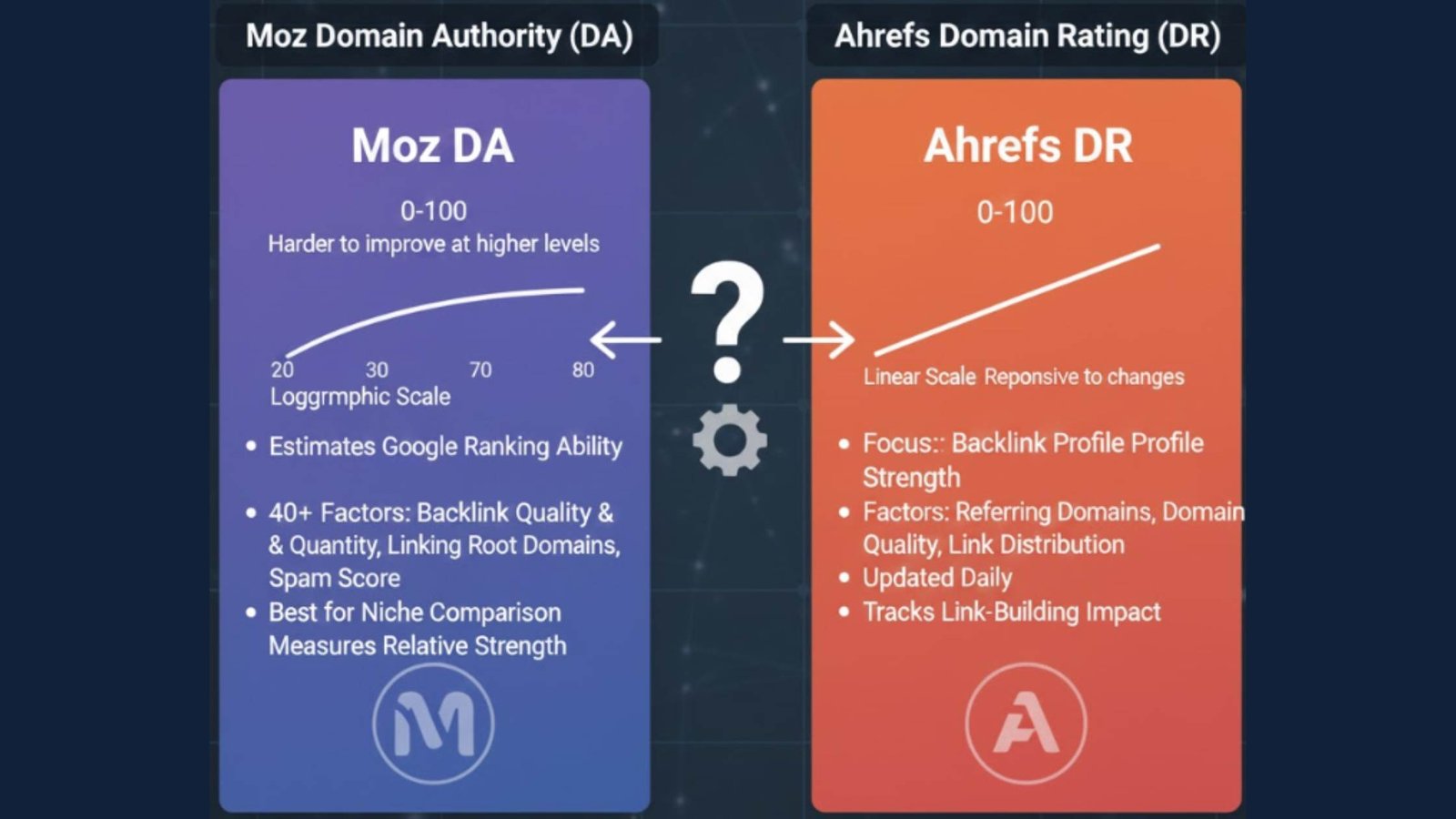
When marketers talk about Moz Domain Authority (DA) and Ahrefs Domain Rating (DR), a common question is: “Do these scores actually help predict how well a site ranks in Google?” The short answer: neither metric directly influences rankings, but both can correlate with ranking outcomes because they reflect backlink strength, a known component of Google’s algorithm.
Both scores are proxy indicators, not official signals used by Google. They help estimate relative competitiveness, not guarantee rankings.
Metric | What It Measures | Direct Ranking Factor? |
Moz DA | Predicts overall SEO strength based on many factors, including links and spam indicators | No (third-party metric) |
Ahrefs DR | Focuses on backlink profile strength — unique referring domains + quality | No (third-party metric) |
Studies and SEO analyses show that strong link profiles tend to correlate with better rankings, simply because backlinks do matter for SEO. However, the relationship between a raw DA/DR score and actual top‑10 rankings is weak when used in isolation — especially when you don’t factor in modern search signals like content quality, user experience, or intent alignment.
SEO research communities also confirm that:
In other words, link strength contributes to visibility, but neither DA nor DR alone tells the full story.
Rather than using these scores as a prophecy for ranking positions, smart SEOs use them as filters or trend tools:
It’s vital to separate the two ideas:
A strong backlink profile helps your SEO strategy, but boosting DR alone without quality content or relevance typically won’t move the needle on competitive keywords.
Incorporate Domain Authority (DA) and Domain Rating (DR) into a dynamic SEO dashboard that also features essential metrics such as:
A combined approach, rather than relying on a single metric, provides the most accurate picture of true SEO performance.
Did you know that Google relies on a complex web of hundreds of ranking signals to determine search results? Each signal plays a crucial role in how websites are evaluated and ranked, ensuring that users find the most relevant and high-quality content.
A domain with moderate DA or DR but excellent relevance and content quality can outperform competitors with higher authority scores. This reinforces the idea that these metrics are tools, not truths.
Instead of choosing one over the other, a combined strategy gives you a more accurate picture:
Use DA to Gauge:
Use DR to Evaluate:
Together, they help you make data‑informed decisions rather than following score vanity.
Instead of treating DA or DR as scoreboard goals, SEO pros use them as trend indicators or filters to understand where they stand compared to competitors. Here’s how you can interpret them effectively: