
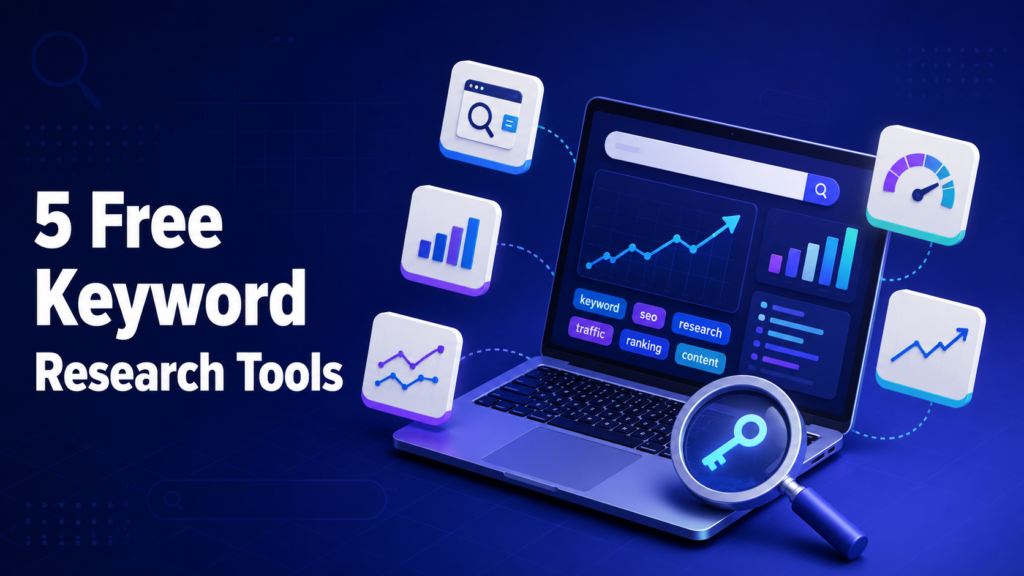
The 5 Best Free Keyword Research Tools in 2026
Keyword research used to mean one thing: finding the exact phrases people typed into Google. In 2026, the search landscape is far broader. While traditional Google searches remain vital, audiences now ask conversational questions in ChatGPT, consult Gemini, and review Google AI Overviews without ever clicking an external link. If your keyword strategy hasn’t adapted to Generative Engine Optimization (GEO) alongside traditional SEO, you’re optimizing for a search engine model of the past.
The good thing is that you don’t need a five-figure software subscription to get high-quality search data. Some of the most reliable keyword metrics come directly from first-party platform sources, and they are completely free.
At Odyssey Marketing, we build performance-driven content strategies every week. Here are the five free keyword research tools we rely on most, along with actionable workflows for each.
1. Google Keyword Planner
Best for: Direct search volume baselines and PPC/SEO alignment.
Google Keyword Planner remains the most foundational source for search volume data. Unlike third-party platforms that rely on clickstream modeling or scraped estimations, Keyword Planner sources metrics directly from Google’s advertising network. When you need a reliable benchmark for monthly search demand, this is your primary reference point.
How to Access It Free
You do not need an active ad spend to use Keyword Planner. Simply set up a free Google Ads account, select “Switch to Expert Mode”, and choose “Create an account without a campaign”. Navigation to Tools & Settings > Keyword Planner gives you full access to search volume estimates, historical trends, competition metrics, and suggested bid benchmarks for any target phrase or URL.
Key Nuance: Non-paying accounts will see broad volume ranges (e.g., 1K–10K) rather than exact numbers. However, these directional ranges are more than sufficient for establishing topic priority during initial content mapping.
2. Google Search Console
Best for: Finding quick-win optimization opportunities on content you’ve already published.
Google Search Console (GSC) is not a traditional discovery engine; instead, it reports real-world user interactions with your verified domain. It exposes the precise search queries driving impressions, clicks, CTR, and average positions for your live pages.
| Strategy Phase | Target GSC Action |
| Metric Target | Pages ranking between positions 8 and 20 |
| Primary Focus | Striking-distance keywords with high impressions |
| Optimisation Action | Refine H2 headings, update title tags, and add FAQs |
| Operational Requirement | Ownership or verified delegate access to the domain |
The Striking Distance Strategy
To capture rapid traffic growth, navigate to the Performance Report and filter for queries where your site ranks between positions 8 and 20. These are topics where Google already views your site as authoritative, but your content isn’t yet positioned above the fold. Updating these pages with targeted subheadings, expanded context, or structured schema can quickly lift them into the top five search results.
Audit Recommendation: Need assistance auditing your site’s striking-distance rankings? Schedule an SEO Strategy Review with Odyssey Marketing to turn untapped impressions into qualified organic traffic.
3. Semrush (Free Account)
Best for: Competitor keyword gap analysis and domain profiling.
While Semrush is known for its premium tier, its free account option remains an effective tool for competitive intelligence. Entering a direct competitor’s URL reveals their top organic traffic drivers, top-performing pages, and overall keyword positioning.
Identifying Keyword Gaps
When a competitor outperforms your site on a core industry term, running their domain through Semrush highlights specific keyword gaps—queries they rank for that your domain currently misses.
- Free Tier Allowance: 10 searches per day across Domain and Keyword Analytics.
- Best Practice: Export full reports per query to maximize data value within daily limits.
4. Ahrefs Free SEO Tools
Best for: Fast keyword difficulty (KD) scoring and SERP evaluation.
Ahrefs offers a suite of standalone free utilities, including its Free Keyword Generator and Keyword Difficulty Checker. Entering a core seed keyword returns up to 100 related phrase ideas along with Ahrefs’ Keyword Difficulty (KD) metric.
| Seed Keyword Entry | Action |
| Start | Enter the seed keyword |
| Keyword Difficulty (KD) | Check KD score from 0–100 |
| High KD (>50) | Pivot to long-tail variations or target specific sub-topics |
| Low KD (<30) | Proceed with the content brief and competitor SERP review |
The KD score is what makes this tool worth bookmarking. Before you commit hours to a piece of content, it helps to know whether you’re walking into a keyword dominated by established sites with thousands of backlinks. A quick difficulty check can save you from targeting a term you were never going to rank for anyway, and point you toward a more realistic long-tail alternative instead.
Ahrefs also offers a free SERP overview for many searches, showing you which pages currently rank and giving you a rough sense of what Google expects that content to look like. Combined with the Keyword Generator, it’s a fast way to shortlist and sanity-check keyword ideas before you build out a full content brief.
5. Google Trends
Best for: Real-time topic validation and seasonal planning.
While standard volume tools measure past search activity, Google Trends monitors relative search interest in real time. It illustrates whether search interest is expanding, flat, or declining across specific geographic regions.
Operational Use Cases
- Seasonal Content Strategy: Identify exact ramp-up periods for recurring industry searches to publish content well ahead of consumer demand spikes.
- Breakout Queries: Monitor the “Related Queries” module for rising searches that haven’t registered in traditional volume tools yet.
- AI Search Alignments: Cross-check emerging topics to ensure your content addresses brand-new user search patterns.
How to Combine These Tools
None of these five tools does everything, and that’s fine, because you don’t need one tool that does everything. Here is the step-by-step workflow used to plan and launch search campaigns:
- Trend Discovery: Use Google Trends to validate rising interest in your target topic niche.
- Volume Baseline: Check Google Keyword Planner to establish baseline search volume ranges.
- Competitive Audit: Run top-ranking competitor domains through Semrush to spot content structure gaps.
- Feasibility Sanity-Check: Filter target terms through Ahrefs Free Keyword Generator to verify Keyword Difficulty scores.
- Post-Launch Tracking: Monitor indexation, CTR, and position progression inside Google Search Console once content goes live.
That sequence takes you from idea to published page to ongoing optimization, all without a paid subscription.
Where Free Tools Reach Their Limit
Free keyword research platforms provide reliable, first-party data to establish early momentum. However, scaling enterprise campaigns across multi-regional markets or large product catalogs often introduces friction, such as search caps, data sampling, and directional volume ranges.
Managing search visibility across both traditional search engines and AI generative models requires continuous strategy, technical auditing, and content optimisation. If you prefer a comprehensive SEO strategy tailored to your growth goals, Odyssey Marketing provides end-to-end SEO execution, content generation, and technical implementation designed to keep your brand visible wherever your audience searches.
Frequently Asked Questions
How do I find long-tail keywords using free tools?
You can discover long-tail phrases by entering broad seed terms into the Ahrefs Free Keyword Generator, which pulls up to 100 related low-competition queries. Additionally, review the “Related Queries” section in Google Trends and analyze the multi-word phrases your site already gets impressions for in Google Search Console.
What is the ideal Keyword Difficulty (KD) score to target on a budget?
For new or lower-authority domains, aim for terms with an Ahrefs KD score under 30. These lower-difficulty keywords typically require fewer high-authority backlinks to rank on the first page, allowing you to drive targeted organic traffic without an extensive link-building budget.
How often should I update existing content using Search Console data?
A quarterly review of Google Search Console is recommended. Audit pages that have been live for at least 3 to 6 months to identify “striking distance” keywords (positions 8–20), then refresh subheadings, add targeted FAQs, and expand relevant sections to boost their rankings into the top five.
What is the difference between Google Keyword Planner and Google Search Console?
Google Keyword Planner provides market-wide search demand estimates based on Google Ads data, making it ideal for discovering new keywords. Google Search Console tracks actual impression and click performance specifically for content on your verified website.
Can I do professional SEO research using only free tools?
Yes! Combining first-party data from Google Keyword Planner, Search Console, and Google Trends with free competitor diagnostics from Ahrefs and Semrush provides sufficient data to build, publish, and optimize competitive content.
How does AI search affect keyword research in 2026?
AI features like Gemini, ChatGPT, and Google AI Overviews prioritize conversational intent, entities, and direct answer formats. Modern keyword research must focus on answer-based long-tail queries and structured context in addition to traditional search volumes
Final Thoughts
You don’t need a five-figure SEO stack to do solid keyword research in 2026. Google Keyword Planner and Search Console give you first-party data straight from the source. Semrush and Ahrefs’ free tools fill in competitor insight and difficulty scoring. Google Trends keeps you ahead of what’s coming next. Used together, they cover most of what a paid tool would offer, minus the invoice.
Start with the tool that matches your most immediate question. If you don’t know what people are searching for, start with Trends or Keyword Planner. If you already have content live and want to improve it, start with Search Console. Either way, the data is there, and it’s free.