
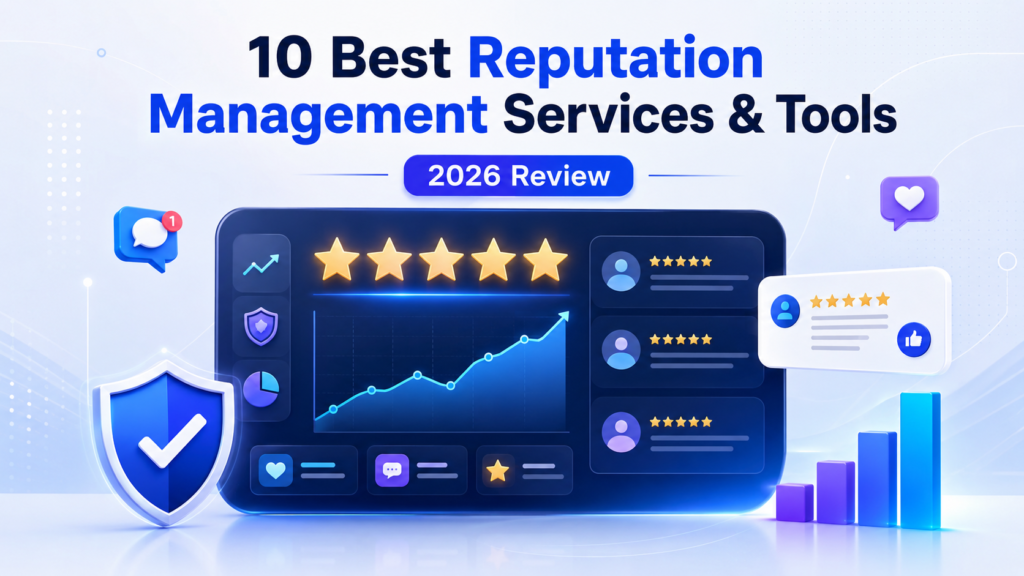
The 10 Best Reputation Management Services and Tools for 2026
Before someone calls your business, books an appointment, or adds an item to their cart, they do one thing first: they Google your name. In seconds, potential clients scroll through your reviews, scan social media conversations, and compare your star rating against your closest competitors. That quick search shapes a purchase decision that used to require a full conversation. In 2026, online reputation management extends far beyond simply replying to a 1-star review. It now encompasses:
- AI Search Summaries: How tools like ChatGPT, Gemini, and SearchGPT summarize your brand reputation.
- Omnichannel Social Listening: Tracking rapid-fire conversations across TikTok, Reddit, and X.
- CX & Review Signals: Capturing structured feedback via SMS, surveys, and support tickets before negative sentiment reaches public forums.
- Local SEO & Citation Accuracy: Keeping your Name, Address, and Phone number (NAP) synchronized across hundreds of directories.
This guide compares 10 top reputation management services and platforms, outlining exactly which business model each one serves best.
What Is Reputation Management
Online Reputation Management (ORM) is the practice of monitoring, responding to, and strategically shaping how your business is perceived online. It helps to divide solutions into two primary categories:
| Reputation Management Paths | |
| Reputation Software (SaaS) | Managed Reputation Services |
| Self-serve dashboard | Dedicated marketing execution team |
| In-house team manages ops | Combined SEO, PR, & content ops |
| Best for high-volume internal teams & routine tasks | Best for hands-off execution & complex reputation repair |
Quick Comparison Of Best Reputation Management Services
| Brand | Best for | Primary strength | Ideal business type |
| Odyssey Marketing | Connected SEO & ORM | Fully managed strategy (SEO, AI search, reviews, content) | Growing brands wanting hands-off strategy |
| Birdeye | Multi-location CX & Reviews | All-in-one engagement & AI search tracking | Healthcare, automotive, & retail chains |
| Podium | SMS-first customer chat | SMS first customer communication | Local service & home repair businesses |
| Reputation | Enterprise governance | Analytics and benchmarking at scale | Large, regulated multi-location brands |
| Yext | Listings & citation accuracy | Local search data consistency | Franchise networks & regional chains |
| Brand24 | Real-time social listening | Social listening and sentiment tracking | SMBs, agencies, & PR teams |
| Sprout Social | Social media management | Publishing plus social listening | Digital marketing teams |
| Brandwatch | Enterprise market research | Deep social and audience research | Global consumer goods brands |
| Meltwater | Media & PR monitoring | Press and media intelligence | PR & corporate comms departments |
| Chatmeter | Local search & multi-site CX | Location level reputation reporting | Regional franchises & retail chains |
How We Chose the Best Reputation Management Services
To select the top reputation management tools and services for 2026, we evaluated dozens of platforms against the key capabilities that drive modern brand trust, local visibility, and customer sentiment. Our evaluation focused on five core criteria:
- Core Functionality & Coverage: We assessed capabilities across review generation, automated response workflows, social listening, local citation management, and PR/media monitoring.
- AI & Search Adaptability: Preference was given to platforms that track emerging touchpoints, including AI search answers (e.g., ChatGPT, Gemini), voice search queries, and real-time sentiment analysis.
- Ease of Use & Automation: We measured how efficiently teams can deploy the software, set up automated review requests, manage unified inboxes, and generate actionable analytics.
- Integration & Scalability: Solutions were benchmarked on their ability to integrate seamlessly with existing CRM, POS, and marketing tech stacks, supporting both single-location SMBs and enterprise networks.
- Value & Service Model: We weighed total cost of ownership against overall impact, evaluating both specialised self-serve tools and fully managed, high-touch agency services.
Note on Tool Selection! This list includes a mix of single-purpose point solutions (e.g., dedicated social listening or listings synchronisation) alongside all-in-one platforms and fully managed agency services. Each entry includes clear notes on primary strengths, ideal business size, and specific use cases to help you make an informed choice.
Top 10 Reputation Management Services and Tools
1. Odyssey Marketing
Website: odysseymarketing.ae
Best for: Businesses seeking a fully managed, connected strategy across SEO, local search, reviews, and social brand presence.
Odyssey Marketing provides a managed agency service rather than a standalone software subscription. Instead of handing you a dashboard to manage internally, their team handles local citations, review strategy, content, and search engine optimization as one unified campaign.
[Local SEO & Citations] + [Review Generation] + [Content Marketing] = Unified Brand Trust
- Key Strengths: Hands-off execution; integrates reputation repair directly into organic search visibility strategies.
- Considerations: Requires agency partnership rather than self-serve software access.
2. Birdeye
Website: birdeye.com
Best for: Multi-location enterprises needing unified review generation, listings, surveys, and AI search tracking.
Birdeye centralises review collection, listings management, customer messaging, and web surveys into a single interface. It features specialised tracking for brand perception inside AI search engines like ChatGPT and Gemini.
- Key Strengths: Built to scale effortlessly across dozens or hundreds of physical locations.
- Considerations: Custom quote-based pricing; feature density requires formal staff onboarding.
3. Podium
Website: podium.com
Best for: Local service businesses prioritising fast, SMS-driven review generation and unified inbox messaging.
Podium centers its platform around SMS. Instead of email based review requests, it sends customers a text with a direct link to leave a review, and pulls messages from SMS, webchat, Google, Facebook, and Instagram into one shared inbox. This makes it a strong fit for local businesses that rely on quick, informal communication with customers.
- Key Strengths: Consolidates webchat, SMS, Google, and Facebook messages into one shared inbox.
- Considerations: Does not support review generation for Yelp due to platform policy restrictions.
4. Reputation
Website: reputation.com
Best for: Enterprise organisations requiring centralised reputation scoring, compliance management, and location benchmarking.
Reputation, formerly known as Reputation.com, is built for large, multi location enterprises in regulated or high volume industries such as automotive, healthcare, real estate, and hospitality. It consolidates reviews, surveys, listings, and social mentions into one system, and rolls performance into a single benchmarking score that leadership teams can track across locations.
- Key Strengths: Advanced enterprise governance, benchmark reporting, and compliance controls.
- Considerations: Enterprise-tier pricing and setup complexity make it ill-suited for small, single-location businesses.
5. Yext
Website: yext.com
Best for: Brands needing automated listing management and location data accuracy across global directories.
Yext synchronizes business information (NAP, operating hours, holiday schedules) across search engines, maps, voice assistants, and directories. Updates made once in Yext sync automatically across connected platforms, which reduces the manual work of updating each site individually.
- Key Strengths: Eliminates inconsistent local data that harms Google Local Pack rankings.
- Considerations: Focused primarily on listing sync rather than hands-on review response management or PR monitoring.
6. Brand24
Website: brand24.com
Best for: Real-time social listening, instant sentiment alerts, and online mention tracking.
Brand24 is a social listening tool that tracks brand mentions across social platforms, news sites, blogs, and forums, and applies sentiment analysis to flag whether the conversation is positive, negative, or neutral. It has also added tracking for how AI chat tools describe a brand when asked about it.
- Key Strengths: Quick setup, affordable tier pricing, and instant negative-sentiment alerts.
- Considerations: Purely a listening tool; does not provide review generation, SMS outreach, or citation updates.
7. Sprout Social
Website: sproutsocial.com
Best for: Marketing teams that want social media scheduling, community management, and listening in one workspace.
Sprout Social is a social media management platform that combines content scheduling, audience engagement, customer service tools, and social listening into one workspace. Its listening tools help teams track brand mentions and sentiment across social channels alongside their day to day publishing work.
- Key Strengths: Excellent UI for social media managers balancing content publishing with brand sentiment tracking.
- Considerations: High per-seat pricing; lacks local business review tools (e.g., Google Business Profile listing sync).
8. Brandwatch
Website: brandwatch.com
Best for: Global enterprise brands conducting deep consumer research, market trend forecasting, and competitive sentiment analysis.
Brandwatch is built for teams that need deep, research grade social listening rather than day to day review or reputation monitoring. It aggregates large volumes of public social and forum conversation, applies AI driven sentiment and theme detection, and is often used by insights, research, or brand strategy teams to inform product and marketing decisions.
- Key Strengths: Deep data analysis, flexible visualisation, and advanced trend mapping.
- Considerations: Designed for data analysts; overbuilt for routine local business review collection.
9. Meltwater
Website: meltwater.com
Best for: PR and communications departments needing media monitoring, press tracking, and influencer intelligence.
Meltwater combines media monitoring, social listening, journalist and influencer databases, and AI powered visibility tracking into one suite built primarily for PR and communications teams. It covers a wide range of sources, including news outlets, broadcast coverage, and podcasts, alongside social platforms.
- Key Strengths: Robust media relations database and broadcast coverage tracking.
- Considerations: Focused on corporate communications and PR rather than local customer review acquisition.
10. Chatmeter
Website: chatmeter.com
Best for: Multi-location franchises seeking local search optimisation and location-level sentiment analysis.
Chatmeter centralises listings management, review monitoring, and local search performance for businesses with many physical locations, and includes AI driven sentiment analysis that surfaces recurring issues, such as service complaints tied to a specific region. In 2026, Chatmeter was acquired by customer experience platform Alchemer, with its reputation and local search features continuing to operate as part of that broader offering.
- Key Strengths: Location-by-location sentiment breakdowns and local SEO tracking.
- Considerations: Platform features are currently being integrated into Alchemer’s broader customer experience suite.
How to Choose the Right Reputation Management Service
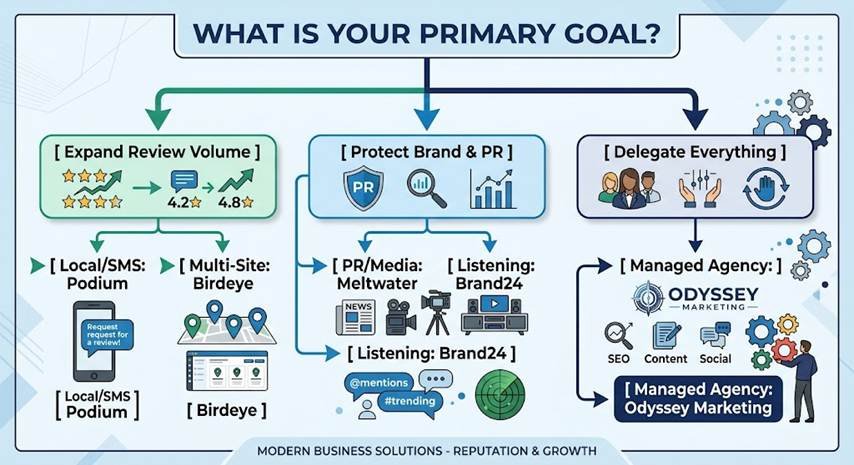
The right choice depends on what a business actually needs to fix or build, not which brand is most talked about.
- For Hands-Off Growth: If you lack the internal bandwidth to manage software dashboards, choose a managed provider like Odyssey Marketing that executes SEO, content, and review management for you.
- For High-Volume Text Messaging: If you run a local home-services business or medical practice, select an SMS-first platform like Podium.
- For Multi-Location Synchronization: If you manage 10+ retail locations or a franchise, utilize Yext (for listings) or Birdeye / Chatmeter (for reviews and local search).
- For Corporate PR & Sentiment Monitoring: If you need to monitor press releases, crisis communications, or social mentions, choose Meltwater, Brand24, or Brandwatch.
Want a Stronger Online Reputation Without Managing Everything Yourself
Managing your online reputation requires a strategy that aligns with your available resources, location footprint, and growth targets. Whether you choose self-serve software or a managed agency partner, maintaining a proactive reputation strategy is essential for capturing search demand in 2026.
If you prefer an expert team to handle your local SEO, review strategy, and digital brand presence, contact Odyssey Marketing today. Discover how a tailored digital marketing strategy can protect and grow your business.
Frequently Ask Questions
What does a reputation management service do?
A reputation management service monitors what is said about a business online, manages customer reviews, tracks brand mentions across the web, and works to improve how the business appears in search results. Depending on the provider, it may also include SEO, content, and social media support as part of a broader strategy.
How much do reputation management services cost?
Costs vary depending on the scope of services, as well as the company or tool you choose.
- DIY Software (SaaS): Ranges from $50 to $500+/month per location depending on feature depth.
- Enterprise Software: Custom enterprise plans usually range from $1,000 to $5,000+/month.
- Fully Managed Services: Managed agency retainer models typically range from $1,500 to $10,000+/month, depending on the inclusion of SEO, content creation, and active PR support.
If you’re looking for premium digital marketing services at competitive prices, get in touch with us today and let’s grow your brand with proven strategies.
What is the difference between review management and reputation management?
Review management focuses specifically on generating, monitoring, and responding to customer reviews on sites like Google, Yelp, and Trustpilot. Reputation management is broader, covering search engine results, social media sentiment, press coverage, local citation accuracy, and general brand perception.
Is reputation management software worth it for a small business?
It depends on review volume and goals. A small business with a steady stream of customer interactions can benefit from automated review requests and monitoring. A business with very few reviews or limited online activity may get more value from a lighter tool or a managed service instead of a full software subscription.
How long does it take to repair a damaged online reputation?
Results vary based on starting point and goals. Basic tasks like updating incorrect directory information or responding to recent negative reviews take 2 to 4 weeks. However, pushing down negative search results, generating a steady stream of positive customer reviews, and improving local pack rankings typically requires 3 to 6 months of consistent effort.
What is the difference between review management and reputation management?
Review management focuses specifically on collecting, monitoring, and responding to customer reviews. Reputation management is broader, covering reviews alongside search visibility, social listening, media mentions, and overall brand perception across every channel where customers form an opinion of a business.
Final Notes
Managing an online reputation requires a holistic approach that connects reviews, search visibility, social listening, and overall customer experience. Because no single platform excels at every requirement, businesses must align their tooling with their precise operational footprint and strategic priorities.
Focused platforms like Yext, Brand24, and Meltwater target specialised tasks such as listing accuracy, social listening, and PR monitoring. Conversely, comprehensive solutions like Birdeye, Reputation, and Chatmeter deliver enterprise-grade governance tailored for multi-location operations and regional franchises.
For organisations preferring a hands-off approach, fully managed agency services, such as Odyssey Marketing, unify SEO, review generation, and brand messaging under a single strategy. Ultimately, long-term success relies on choosing a model matched to your business scale, team bandwidth, and growth targets.