
Generative Engine Optimisation (GEO): The Complete Guide for Modern Search
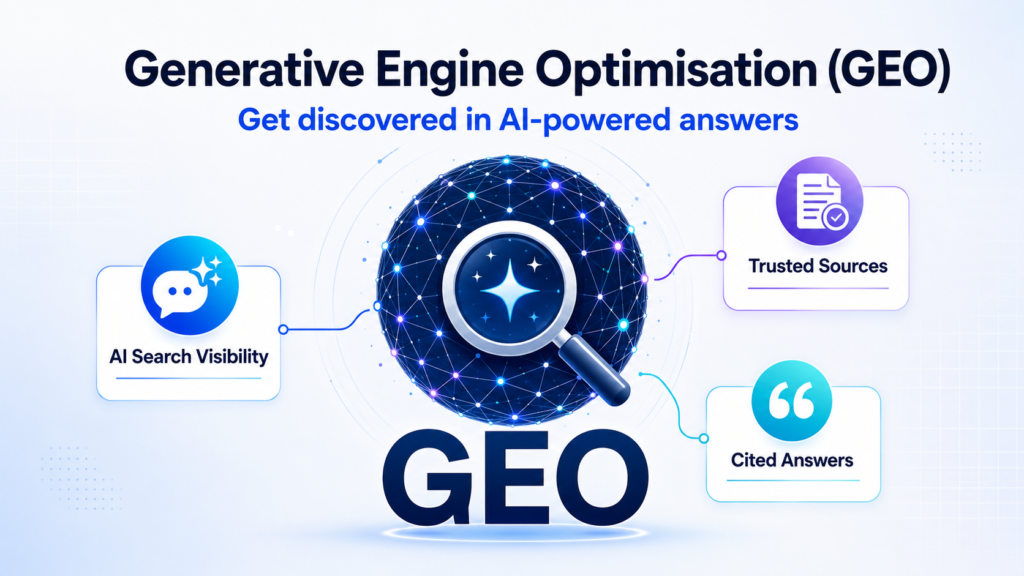
Search is moving far beyond traditional blue links. AI-powered search engines now process complex questions, cross-reference multiple sources, and deliver direct conversational answers. Generative Engine Optimisation (GEO) helps AI systems understand your business, content and expertise. It aims to improve your brand’s chances of being accurately represented in AI generated answers.
GEO does not replace Search Engine Optimisation (SEO). While SEO helps users find your website via traditional rankings, GEO helps AI engines extract, process, and cite your insights within AI-generated responses.
Quick Answer: What Is Generative Engine Optimisation
Generative Engine Optimisation (GEO) is the process of making your brand’s digital presence easier for AI-powered search and generative engines to understand, trust and potentially reference in generated answers. GEO focuses on areas such as:
- Creating useful, original and comprehensive content
- Clearly answering the questions your audience asks
- Building topical authority
- Making your brand and business information consistent
- Strengthening relevant authority and reputation signals
- Using clear website structure
- Improving technical SEO and crawlability
- Using appropriate structured data
- Creating content that demonstrates real expertise and experience
- Monitoring how your brand appears in AI-generated answers
The goal is not to “trick” an AI system. The goal is to become a clear, credible and useful source of information.
Why Is Generative Engine Optimisation Important
People no longer use search in only one way. Someone researching a marketing agency, software platform, financial product, restaurant, healthcare service or business solution may now ask an AI-powered search tool a question such as:
- What are the best digital marketing agencies for a small business?
- How can I improve my website’s organic traffic?
- Which SEO strategy should a B2B company use in 2026?
The answer may combine recommendations, explanations and sources, which means visibility is becoming more than simply ranking for a keyword. Your business increasingly needs to be understood as an entity and recognised as a useful source of information.
Google’s current guidance for generative AI search makes an important point: its AI search features are grounded in Google’s existing Search systems, meaning established SEO practices continue to matter.
So, GEO shouldn’t be treated as a replacement for SEO. Think of it instead as an extension of a strong search and content strategy.
10 Practical Steps to Optimise for Generative AI Search
Generative AI systems don’t simply look at one keyword and decide which page should appear. AI-powered search experiences process a question, identify relevant information, and generate a response using the information available to them. For businesses, that means your content needs to be clear, relevant, helpful, trustworthy and accessible. Here’s how to get there.
1. Answer Specific Customer Questions Early
Structure content around explicit questions your target audience asks during sales calls and research phases. State the direct answer within the first two sentences before diving deeper into nuances.
For example, instead of a generic page called “Digital Marketing Services”, you could create useful resources such as:
- What Is Digital Marketing?
- How Much Does Digital Marketing Cost?
- How Long Does SEO Take?
- SEO vs PPC: Which Is Better for Your Business?
- How Can a Small Business Generate More Leads Online?
- What Is Generative Engine Optimisation?
- How Does Google AI Search Work?
These pages answer real questions. That makes them useful to people and gives search systems clear information to understand.
2. Build Comprehensive Topical Clusters
Don’t make readers work through 1,500 words before they find the answer. Start your article with a concise explanation, then go deeper.
This approach works because readers can quickly grasp the topic while those who want more detail can keep reading. It also gives search engines and AI systems a clear structure to interpret.
3. Establish Clear Entity Signals
One article rarely proves that a website is an expert on an entire subject. If your business wants to be known for SEO, don’t publish a single article; build a useful collection of related resources: what SEO is, how it works, on-page and technical SEO guides, keyword research, local SEO, SEO for small businesses, SEO vs PPC, how long SEO takes, common mistakes, reporting, and so on.
Connect these articles through relevant internal links, and over time you build a genuinely stronger topical resource for your audience.
The important part isn’t publishing dozens of pages simply because you can; Google specifically advises against producing large amounts of content primarily for search engines without adding value. Quality beats quantity.
4. Provide First-Hand Insights and Data
Generic summaries get ignored by AI crawlers. Integrate proprietary data, case studies, client results, and original commentary that cannot be replicated by automated text tools.
A statement like “Odyssey Marketing helps businesses improve their digital marketing through SEO, content, paid advertising and conversion-focused strategies” is far easier to understand. Clarity is an underrated part of both SEO and GEO.
5. Demonstrate Real Experience and Expertise
AI search is not a reason to publish generic information that could have been written by anyone; in fact, it’s one of the biggest opportunities for businesses.
Add information only your business can provide original research, first-hand experience, customer insights, case studies, campaign results, expert opinions, industry observations, original examples, data and practical processes.
Google’s people-first content guidance encourages original information, analysis and content that genuinely satisfies the user’s goal. This is where a real business has an advantage over generic, AI-generated websites. Your experience is your differentiator.
6. Use Clear Headings and Content Structure
A good article should be easy to scan: one clear H1, descriptive H2s, H3s where needed, short paragraphs, bullet points, numbered steps, tables for comparisons, examples, definitions and FAQs. A structure like this makes an article easier for both humans and machines to navigate:
- What Is Generative Engine Optimisation?
- Why Does GEO Matter?
- How Does GEO Work?
- GEO vs SEO
- How to Optimise Your Website for AI Search
- Common GEO Mistakes
- Frequently Asked Questions
7. Strengthen Strategic Internal Linking
Internal links help users discover related information on your website, and they help search engines understand how your pages connect. This article, for example, could reasonably link to pages about SEO services, content marketing, technical SEO, local SEO, digital marketing, keyword research, AI marketing and website optimisation.
Don’t add links simply for the sake of adding them. Ask: would this link genuinely help the reader understand the topic better? If yes, add it.
8. Maintain Off-Site Brand Consistency
Your website is only one part of your online presence. People and search systems encounter your business across industry websites, business directories, news publications, professional profiles, review platforms, social media, partner websites, interviews, podcasts, events and author pages.
Keeping your business name, services, location, expertise and contact information consistent across these platforms makes it easier for people, and AI systems to understand who your business is.
9. Implement Accurate Structured Data
Structured data helps search engines understand information on a webpage. Depending on the page, relevant schema types can include Organisation, Local Business, Article, Breadcrumb List, Product and Service.
The correct schema depends on what the page actually represents; don’t add it simply because you heard it can improve rankings.
Google states that structured data can make pages eligible for certain search features, but correctly implemented structured data does not guarantee that a particular feature will appear.
Rule Simple! Markup what’s genuinely present on the page.
10. Audit Brand Visibility Across AI Engines
A brilliant article is useless if search engines can’t access or index it. Check that important pages are indexable and accessible to crawlers. Ensure robots.txt, noindex tags, internal links and canonical tags are correctly configured. Also, keep your site mobile-friendly, fast and accessible to search engines.
Periodically test high-intent industry queries across ChatGPT, Claude, Gemini, and Google AI Overviews to monitor how your brand is cited compared to competitors. Google’s current generative AI guidance specifically recommends following crawling, indexing, technical SEO and page-experience best practices.
GEO vs SEO: What’s the Difference
SEO and GEO overlap significantly, but they aren’t exactly the same thing.
| SEO | GEO |
| Focuses on visibility in search engines | Focuses on visibility in generative AI experiences |
| Targets organic search results | Targets AI-generated answers and recommendations |
| Uses keywords and search intent | Uses questions, topics, entities and context |
| Builds rankings and organic visibility | Builds the likelihood of being understood and referenced |
| Relies on technical SEO and content | Relies on technical SEO, content, authority and clarity |
| Drives users to webpages | Can influence how brands are represented in generated answers |
The important takeaway: you don’t need to choose between SEO and GEO. A strong SEO foundation supports your visibility in AI-powered search. Google explicitly states that existing SEO best practices remain relevant to AI Overviews and AI Mode.
GEO vs AEO: Are They the Same
You may also hear the term AEO — Answer Engine Optimisation. AEO generally focuses on structuring content so it can provide direct answers to questions in search experiences. GEO is a broader concept focused on visibility within generative AI experiences overall.
There’s overlap between the two; clearly and directly answering “How much does SEO cost?” supports both traditional search visibility and AI-powered answer experiences. Rather than worrying too much about which acronym applies, focus on the underlying objective: create authoritative content that clearly answers the questions your audience is asking.
How to Optimise Your Website for Generative AI Search
If you want to start improving your website today, follow this practical process.
Step 1: Identify Your Audience’s Questions
What do customers ask before contacting you? What do sales teams hear repeatedly? What problems are they trying to solve, what comparisons do they make, and what stops them from buying?
Step 2: Research Search Intent
“What is SEO? is informational. SEO agency near me” has local and commercial intent. “Best SEO agency for dentists” has commercial investigation intent. Your content should match the reason behind the search.
Step 3: Create the Best Answer You Can
Don’t simply rewrite the first-page results; add something better: clear explanations, practical examples, original insights, relevant data, expert commentary, useful visuals, FAQs and step-by-step guidance. Google’s guidance emphasises creating unique, valuable, non-commodity content rather than another version of information that already exists.
Step 4: Improve Your Website Structure
So, it clearly moves from brand to services, to topics, to expertise, to supporting content a logical information architecture a reader (or a machine) can follow.
Step 5: Strengthen your authority
Through genuine PR, industry contributions, expert interviews, original research, partnerships, relevant directories, guest contributions and customer reviews, and avoid artificial schemes designed purely to manipulate rankings.
Step 6: Monitor AI visibility
Build a list of questions your potential customers might ask AI:
- “What is the best marketing agency for small businesses?”
- “How can I improve my website traffic?”
And periodically check how different AI search experiences describe your business and competitors.
Track whether your brand appears, how it’s described, which competitors appear, which sources are mentioned, and whether important information is missing or inaccurate. That gives you something far more useful than simply saying “we are doing GEO”; you can measure changes in visibility and representation over time.
10 Practical GEO Actions You Can Implement Today
- Strengthen Your About: Clearly explain who you are, what you offer, and which customers your business helps.
- Build Dedicated Services: Create detailed, useful pages that clearly explain each service, its benefits, and customer value.
- Answer Customer Questions: Turn common customer questions into genuinely helpful articles that provide clear, practical, trustworthy answers.
- Show Real Experience: Add case studies, first-hand insights, and real examples demonstrating your expertise and practical experience.
- Create Topic Clusters: Connect related content through thoughtful internal links to build stronger topical relevance and authority.
- Improve Author Information: Show who creates your content, their expertise, and why readers can trust their knowledge.
- Maintain Business Accuracy: Keep your business details accurate, consistent, and updated across important online platforms and directories.
- Fix Technical SEO: Resolve technical issues so important pages can be crawled, indexed, understood, and accessed properly.
- Add Accurate Structured Data: Use relevant structured data that accurately describes your content without adding misleading or unsupported information.
- Test AI Search: Regularly test relevant customer questions across AI search experiences to understand visibility and identify improvement opportunities.
Common Generative Engine Optimisation Pitfalls to Avoid
GEO is embarking on an exhilarating journey of transformation, but as we forge ahead, a few bumps in the road are beginning to emerge.
Mistake 1: Thinking GEO is a Magic Trick
There’s no guaranteed formula that makes an AI system mention your company. Anyone promising guaranteed inclusion in ChatGPT, Google AI Overviews or another AI search system should be treated cautiously; visibility depends on many factors and can change over time.
Mistake 2: Publishing hundreds of AI-generated Articles
More content doesn’t automatically mean more visibility. Google’s guidance warns against using generative AI to produce large amounts of content without adding value for users. Use AI as a tool, not your entire content strategy.
Mistake 3: Writing for AI Instead of People
If your article sounds robotic or unnatural, you’ve gone too far. The best test is simple: would a real customer enjoy reading this? If not, improve it.
Mistake 4: Keyword Stuffing
Repeating a target phrase repeatedly doesn’t make an article better. Use terminology naturally and explain concepts in normal language.
Mistake 5: Ignoring Traditional SEO
GEO doesn’t mean you can forget technical SEO, search intent, internal linking, page experience, crawlability, indexing, quality content and site architecture. Google’s own guidance says SEO remains foundational for its generative AI search experiences.
| Ready to Improve Your GEO Strategy? Avoid common GEO mistakes and build a search strategy designed for both AI visibility and real users. Get Your Free SEO Consultation |
Does AI-Generated Content Hurt SEO
Not automatically! Google’s guidance focuses on quality, accuracy, relevance and user value, rather than simply whether AI was used to produce the content. AI can be genuinely useful for research, brainstorming, outlining, organising information, finding content gaps and improving drafts. But publishing large volumes of low-value content just to capture search traffic can create problems. A stronger workflow looks like the following:
- 1ST AI Assistance
- 2ND Human Expertise
- 3RD Fact-checking
- 4TH Original Insight
- 5TH Editorial review
- 6TH Publication
Can GEO Help a Business Appear in Google AI Overviews
Potentially, but with an important distinction. There’s no special “GEO switch” that guarantees inclusion in Google AI Overviews. Google says pages need to meet the normal technical requirements for Google Search and be eligible to appear with a snippet, and that there are no additional technical requirements specifically for AI Overviews or AI Mode.
The practical strategy, then, is to create genuinely useful content, make it crawlable and indexable, match search intent, build topical relevance, demonstrate expertise and experience, maintain strong technical SEO, and keep improving the page based on user needs.
How Long Does GEO Take to Work
There isn’t a universal timeline for SEO improvements. Some changes may yield quick results, while establishing stronger authority and visibility can take more time. This duration depends on various factors, such as website authority, competition, industry, content quality, existing rankings, technical health, brand recognition, digital public relations, content depth, and search demand.
It’s important to view SEO as an ongoing marketing strategy rather than a one-time technical task.
How Should You Measure GEO
Don’t rely on a single metric. Track a combination of traditional and AI-search signals.
Traditional SEO Metrics: Organic clicks, organic impressions, rankings, organic conversions, search visibility, indexed pages.
AI Visibility Metrics: Brand mentions, AI recommendations, citation frequency, sources of mentions, competitor mentions, accuracy of descriptions, visibility for target questions, and measurable referral traffic from AI platforms.
The objective isn’t simply “did an AI mention us?” The better question is: is our brand becoming more visible, accurate and relevant across the places our customers search?
A Simple GEO Strategy for Digital Marketing
For digital marketing, the best approach is to turn expertise into a connected content ecosystem, starting with core commercial pages, then building supporting educational content around them. For example, a core service like Digital Marketing Services could be supported by topics such as:
- What Is Digital Marketing?
- How Does Digital Marketing Work?
- Digital Marketing Strategy Guide, SEO vs PPC
- How to Generate More Online Leads
- How to Measure Digital Marketing ROI
- Digital Marketing for Small Businesses
- Common Digital Marketing Mistakes
- What Is Generative Engine Optimisation?
- How AI Is Changing Search
Each piece should serve a real audience need, then connect naturally through internal links, creating a website that’s useful to people and easier for search systems to understand.
The Future of Search Is Not Just About Rankings
Search is becoming more conversational. People can ask longer questions, ask follow-ups, compare options, and ask for recommendations. AI-powered search experiences can help them explore information without visiting several websites first.
That doesn’t mean websites are disappearing; it means the role of content is changing. Your website needs to become a source that’s useful, clear, credible, original and easy to understand. That’s the real opportunity behind Generative Engine Optimisation.
Want Your Brand to Be Visible in the New Era of Search
Search is no longer limited to traditional search results. As people increasingly use AI-powered experiences to research questions, compare businesses and find solutions, your brand needs to be easy to understand wherever your customers are searching.
Odyssey Marketing can help you build a search strategy that combines strong SEO, useful content and modern AI-search visibility. Ready to make your brand easier to find, understand and trust? Talk to digital marketing specialists today!
Book a Free Consultation
Frequently Asked Questions About GEO
What is Generative Engine Optimisation?
Generative Engine Optimisation (GEO) is the process of improving a brand’s online presence so AI-powered search and generative systems can better understand its content, expertise and relevance, increasing the potential for the brand to be referenced in AI-generated answers.
Is GEO the same as SEO?
No! GEO and SEO overlap, but they focus on somewhat different search experiences. SEO focuses primarily on visibility in traditional search results, while GEO focuses on visibility and representation within generative AI experiences. Strong SEO remains an important foundation for GEO.
Does GEO replace SEO?
No! GEO should complement SEO rather than replace it. Google states that existing SEO best practices remain relevant to AI Overviews and AI Mode.
How can I optimise my website for AI search?
Start with useful, original content; answer customer questions clearly; improve technical SEO; create strong internal linking; demonstrate real expertise; maintain consistent brand information; and make important content accessible to search engines.
Can I guarantee that my business will appear in ChatGPT or Google AI Overviews?
No! There’s no legitimate method that guarantees inclusion in every AI-generated answer or Google AI Overview. AI search results can change based on the query, context, sources and systems involved.
Does structured data guarantee AI visibility?
No! Structured data can help search engines understand information on a page and may make content eligible for certain search features, but Google does not guarantee that structured data will result in a particular search appearance.
Does AI-generated content hurt rankings?
Using AI doesn’t automatically make content harmful. The important factors are quality, accuracy, relevance, originality and user value. Google warns against generating large amounts of content without adding value.
How long does GEO take?
There’s no fixed timeframe. Results depend on the website, industry, competition, authority, content quality and technical foundation. GEO should be treated as an ongoing strategy.
What is AEO?
AEO stands for Answer Engine Optimisation. It generally focuses on creating content that directly answers questions in search and answer-oriented experiences. AEO and GEO overlap, and both benefit from clear, useful content.
Why is GEO becoming important?
People are increasingly using AI-powered experiences to research questions, compare options and discover information. This creates another environment in which businesses need to be understandable, useful and credible.
Final Thoughts
Generative Engine Optimisation may sound technical, but the underlying idea is simple: be the business that provides the best answer.
Create content that solves real problems. Explain complicated subjects in simple language. Show your experience and support your claims. Keep your information accurate. Make your website easy to crawl and understand. Build genuine authority. And give people a reason to trust your brand.
Google’s current guidance reinforces this approach: its generative AI search experiences still rely on foundational Search systems, while its content guidance continues to emphasise helpful, reliable, people-first information.
So don’t think of GEO as a trick for getting an AI to mention your business. Think of it as the next step in building a clearer, more authoritative and more useful online presence, one that benefits your customers whether they discover you through Google, an AI-powered search experience, social media, referrals or your website directly.